Sunday, March 24, 2013

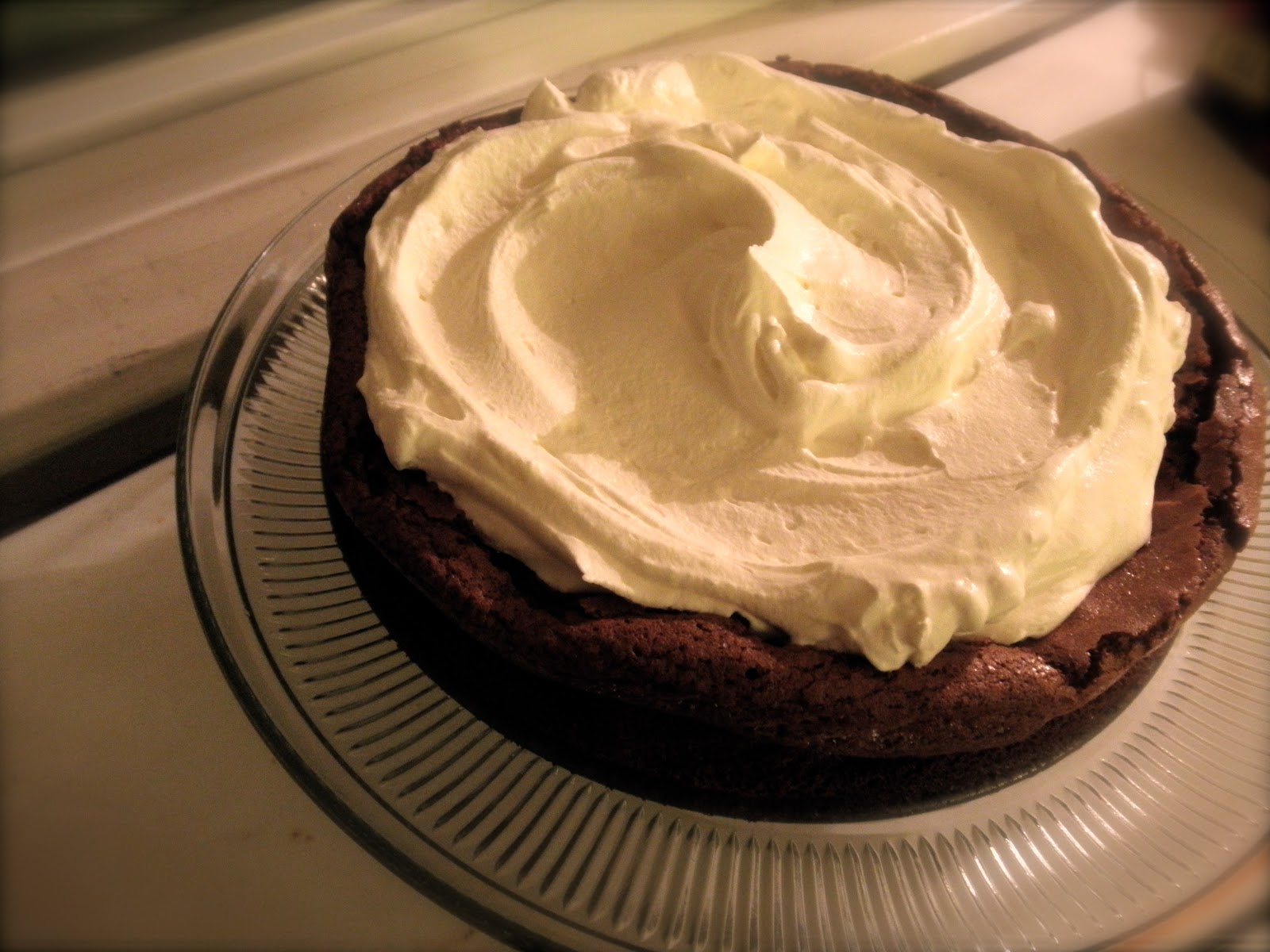
Fallen Chocolate Cake


Not many posts ago, I told you about my 23rd birthday cake. I explained to you that a baker (or at least this baker) prefers to make her own birthday cake, because it's a gift to herself; because she finds catharsis in the process; because she's a little bit controlling. You watched as I greedily snatched the cake duty, and all the love that goes into it, from those in my life who would have liked to bake my birthday treat.

Well, folks: a year has passed. The Earth has completed yet another revolution. I am twenty-four, and just as greedy as ever.


I was under the assumption that Megan making her own birthday cake was an established tradition after one year. I had already taken it for granted. So when I casually mentioned to my sister what I was considering for this year's cake, I did not expect the startled response that I got.

"You're going to make your own birthday cake?"

"I did last year."

"You should let someone else make it."

That "someone else" was in front of me, nodding expectantly with wide eyes and a goofy smile. It was hard to tell which of us wanted it more. So I wavered, ever so slightly:

"I don't know. Maybe..."

Over the next week she wore me down, until I finally relented. She would make my cake.


Regret inevitably followed. I felt like I'd let myself down, like I'd surrendered when I ought to have stood my ground. Days later, Caitlin gave me a chance to take back the cake.

"If you really want to make your cake, I could wait to --"

"Okay."

The cake was mine again! And this time I wasn't letting go.


I think we're well past that time when a cake with no flour is considered wanting; we are all well aware of what magic can happen when gluten isn't around. But flourless chocolate cake is something else entirely. It has disassociated itself from the broad category of flourless baked goods - that is, baked goods that are customarily made with flour, but can exist in almost identical form without flour - and it has become its very own category. Really, it shouldn't even be called cake. 

Cake, in its most familiar form, is light and spongey. It becomes so by way of several chemical and physical processes, but it's the gluten from flour that is largely responsible for giving a cake structure as it expands. Without flour, the cake needs support from other ingredients. For this one, it's the eggs that do the heavy lifting. Whole eggs and egg yolks introduce protein into the batter, creating a similar, albeit weaker, structural network. Then egg whites are whipped and folded in to incorporate air, the physical leavener. That, plus steam, is what makes this cake rise. And rise it did.


Out of the oven, the cake's delicate surface had risen above the rest of it, creating a slivered portal into its dark netherworld. 

Then, true to its name, it fell.


The result is an intensely moist, dense vehicle for a rich chocolate taste that's both sweet and dark. Cake just doesn't seem to do it justice. I'd call it more of a brownie-torte. Top it with a smooth pile of mascarpone whipped cream, and you might even toss cheesecake into the mix. Who's to say, really?

I wanted so badly to get this shot in the light of day. But unless I decided to have a birthday lunch instead of dinner, I would have to accept a lamplit cake.
A lesson on life: opt for living it properly over capturing it properly.

And now, a lesson on mascarpone.

DO:

Add it to your whipped cream whenever possible, especially if it's going to top a dessert that has a strong presence to begin with. It makes the whipped cream thicker, creamier, and just a little bit sweeter.

DO NOT:

Bring what's left of it to work the next day and, in lieu of a proper lunch, eat it with crackers and raspberry jam, thinking blithely that you've got it all figured out. You don't. You will feel disgusting later, and over the next 24 hours you will gag whenever you think of it, unable to shake the cloying taste memory.

I'm sorry to have ended with that; I feel it was my duty as someone who has learned the hard way. Just know this: when used correctly, mascarpone will take you to a very happy place. When used in due fashion, it is worthy of you, your family, and your birthday cake.


Saturday, February 23, 2013

Milk Bar Crack Pie


I debated about this post. I had fully intended to write all about this baking adventure before I tied up my apron. I documented the whole process in photos. And when the pie was sliced and passed around, it wasn’t long before everyone’s plate was scraped clean, ready for a second piece. It was a hit.

Why, then, the debate? Because for me, this pie is a story of high expectations and ultimate disappointment. I know that’s not a promising way to begin a post on a food blog, but it’s the right thing to do. I want you to be prepared. But there’s still a story here, so you mustn’t let the inevitable disappointment deter you from enjoying the journey. Life leads to death, but we still opt to live, right? And just like life, my journey with Crack Pie didn’t come without a bit of fun, a few good drug puns, and a silver lining.


Milk Bar is an NYC bakery within David Chang’s Momofuku empire. Head pastry chef Christina Tosi runs the show there, and it’s her singular taste that gave the place a reputation that precedes it.

I discovered Milk Bar through the pages of its cookbook, written by Tosi and published in 2011. I stood in the book section of Kitchen Window and paged through gorgeous photos of day-to-day ingredients and candid shots of the kitchen staff. Alongside them were all the recipes to Milk Bar’s now-famous desserts. But having been unaware of the shop’s existence until that point, the revealed secrets are not what pulled me in. It was Tosi’s narratives throughout the book that kept me fixed in that aisle, turning the pages. Her prose was casual and edgy, and I immediately respected her. Even though she seemed to be up on a high horse at times, I figured she deserved to be there. Just glance at the Milk Bar menu and you can see it: she’s a dessert visionary.

The oat cookie crust - hands down, the best part of Crack Pie.


It’s funny, because if Tosi is at all pretentious, it’s because she’s trademarked the baking utility of the most unpretentious ingredients. She writes recipes that glorify her favorite sweet and salty snacks – marshmallows, potato chips, pretzels, Ritz crackers, graham crackers… - and she brings those flavors together over one simple, subtle, and soothingly familiar base ingredient: milk.

Virtually every recipe of hers uses some form of it, whether it’s whole milk, heavy cream, milk powder, or some combination thereof. It seems Tosi inadvertently discovered the secret to dessert one-upmanship – at a certain point, you stop fiddling with what’ll seem most exotic and fanciful and you go back to what everyone has loved from day one. You exploit it unapologetically, and you do it better than anyone else. Which isn’t too difficult when no one else is doing it.

So that’s Milk Bar, and that’s Christina Tosi. And that’s why my expectations were so damn high.


I received my copy of Momofuku Milk Bar this Christmas. Over the next couple weeks, I slowly made my way through the book, reading it, more or less, cover to cover. I wanted to make one of the recipes for my sister’s  birthday in early February. I quickly learned that, while Tosi’s raging sweet tooth and salty snack diet give her creations the illusion of accessibility, the lady is still trained in pastry arts – at the French Culinary Institute, to be exact. That means she can not only decide that salted caramel, peanut butter nougat, pretzels, and chocolate will get along more than a little nicely, but she has the knowledge of baking chemistry to make it happen. And she lets us know it, too, with her ingredient list. Alongside the everyday pantry items in Tosi’s recipes, you’ll find glucose, citric acid, gelatin sheets, and pectin. Pectin.

Tosi suggests separating yolks and whites in your hand; it's easier to feel when the last of the egg white has slipped off. You're left with an egg yolk that's surprisingly strong and self-contained. Go ahead, try it.
There are eight egg yolks in this recipe. That's split between two pie tins, but still. Maybe don't schedule any blood work for the next day. 

I narrowed my search to the recipes that would not require shopping for esoteric ingredients on amazon. (I’m not unwilling to do this, by the way. I just want to be sure I’ll have multiple occasions for glucose before I go online and buy a bucket of it.) I decided on Crack Pie because its most foreign ingredients were milk powder and corn powder, both of which I found at Whole Foods. 

I also chose it because it’s called Crack Pie. We’ve all heard of it, Jimmy Fallon has endorsed it, and it references an illicit substance that none of us were cool/stupid enough to have messed around with thus far. Allegedly, the first time Tosi made this pie, her staff flipped and kept crawling back for more. They ran on a high the entire evening, and eventually crashed. It sounded kind of fun. I wanted to know if the hype was legit. Was it really that cracktastic? (Warning: more wordplay to come.)

This is freeze dried corn. You can buy it online or in the bulk section at some Whole Foods. You could ask an employee for assistance if you have trouble finding it, but they will probably just ask you if you mean frozen corn. You don't.  
Mount Crackatoa: sugar, milk powder, and corn powder.

Remember that "bit of fun" I mentioned in my downer introduction? This is where it starts. When I was a kid, one of my favorite pastimes was mixing up concoctions. They were edible concoctions, but only insofar as all the individual components were fit for consumption. (Drawing inspiration from after-school viewings of Great Chefs, I’d really nail the presentation. I remember topping one bowl of beige slop with an artful arrangement of rainbow sprinkles, pine needles, and a pinecone. But I’m getting off point.) 

I’m telling you this because that’s what it was like when I made the Crack Pie. Mixing together sugar and butter and cream and egg yolks offers all the satisfaction of watching disparate ingredients meld together into a thick, glossy, homogeneous soup, only this one was actually meant to be ingested. You can’t get that same satisfaction from civilized desserts that don’t direct you to cram as much fat and cream and cholesterol as will fit into one pie tin. Yes, that’s right. Crack Pie is edible, but it’s completely uncivilized.

This is the kind of beautiful mess I strove toward in my early culinary ventures.


Caitlin's birthday crack pie. It's a pretty bland-looking thing in the end. The powdered sugar helps a bit. The flowerpot with a bow does not.

On the night of Caitlin’s birthday, I showed up at her place with the cold Crack Pie. Having never tried it before, we approached it with some trepidation. We took our first bites, a little afraid of what we might become. Caitlin, Shawn, and Josh all cut a second piece. I was doing fine with my single piece.

I brought the second Crack Pie to work that week. I drafted an email to the entire office, telling them about the treat I brought. “It’s called crack pie because of all the butter and sugar in the filling,” I typed. “It’s totally within the law, except for the crack sprinkled on top.”

See? I was having fun, even if I did delete that last part before sending.

The co-workers went back for seconds, too. But me, I'd had enough after one piece. I don’t know. If I had to describe Crack Pie, I’d say it’s like cookie dough gone bad. Not rancid bad; mean bad. Rough around the edges. Aggressive. Maybe a little malicious? I know, that’s a strong accusation to make against a comestible, but there you go. I guess I expected more.

There are so many beautiful desserts in that book. And now, having introduced you to Tosi and her manifesto, I can move on to the next recipe and subsequently write about it in a blog post that will be both a) more laudatory of the food itself and b) shorter. But that’s not even the silver lining.

Here’s the silver lining: Next time I’m in New York, I will make a special trip to Momofuku Milk Bar. Money will not be an object. I will stare at the big chalkboard menu for fifteen, twenty minutes as my poor, reeling brain narrows the offerings down, not to what money can afford, but to what my stomach will allow. Candy bar pie? Grapefruit pie? Cereal milk ice cream + berry milk crumb? It’s not going to be easy. And if I’d gone there a month ago, the storied Crack Pie would have been a shoo-in. Now, that slot is open. And that’ll make my decision just a little bit easier.

The hero shot, for what it's worth.

Tuesday, January 15, 2013

Chocolate pots de creme


I've had The Art and Soul of Baking by Cindy Mushet since 2010 (it gave me this banana cream pie, by the way). Somewhere between then and now I bookmarked this recipe with a ripped post-it. It was the photo that had caught my attention, I'm sure: a dense pool of milk and dark chocolate, a messy island of whipped cream, and two long chocolate curls, all contained by a clear glass ramekin. Personal pan pudding!

I loved the idea. It would be an adventure, as I'd never made pudding before, and at the end of the day I could curl up like these women and enjoy my sumptuous treat.


These things take time, though. Other recipes come up. Recipes that are more pragmatic and less obscenely indulgent. But amid the acrimony of January, chocolate pots de creme suddenly become sensible.

Why of course, one thinks. My skin is dry and my fingers ice cold, and any body hair I've got, I'm holding on to. Now is the time to be doused with chocolate and beset by cream.


Cream, people. It's all over this thing.

It's heated with milk and sugar, then poured over milk chocolate to create the custard base. Later, semisweet chocolate melts in a hot bath of it until the two are whisked together into a dark ganache. One final batch of it is touched with vanilla and sugar, then whipped for ages until soft pillows form.


You want some cream, don't you?

But wait. We must give credit where it's due. Chocolate and cream do not magically become custard in the oven. It's the egg yolks that give the liquid structure as it heats up. I was aware of this before now, but never as impressed as I should have been.

Fine mesh sieve required. We want the egg proteins, but the rest must go. 
Also noteworthy: custards made with whole eggs are leaner and have more structure; those made with only egg yolks are softer and more luscious. Pots de creme fall in the middle, with both whole eggs and egg yolks.


The chocolate quotient in this dessert is a lot to reckon with, even in just one individual dish. I eat chocolate daily, and I think it's swell. But I'm not a "there's-no-such-thing-as-too-much-chocolate" devotee. As it happened, I only prepared three pots in the middle of the afternoon so there would still be enough natural light to take photos. But the three of us present only dipped our spoons into a single pot, knowing dinner was close, and this would be rich. Even then we couldn't make a clean job of it.


I love eating dessert alone. Sitting at the table, curled up on the couch, hunched over the cooling rack in the kitchen...whatever. And this dessert looks perfect for a solo lady with a solo spoon on a solo evening. But if I had my way, I'd do it a little different.

If I had my way, I'd make a slew of little pots de creme. I'd spend the day in the kitchen, heating chocolate and cream, separating eggs, whisking, baking, and whipping cream. Then I'd serve them to a long table of friends, fresh from a healthy dinner and looking to mess it all up with something rich and sweet. I'd watch them fall silent during their first bites. I'd imagine all that cream and chocolate forming a protective layer over their cold winter bones and tired dry skin.

Later I'd listen to the frantic tapping of spoons on ceramic - the sounds of a loving attempt to get every last bit.


Sunday, December 2, 2012

Homemade Pumpkin Pie


Since I started eating pumpkin pie just a few years ago, I've never questioned the merits of Libby's pure pumpkin in Festal's pie recipe. (We replace all the white sugar with brown sugar - it's so smooth, people.) But at the beginning of October I was looking at the decorative gourds at Trader Joe's. Next to them was a pile of perfectly round, perfectly orange pie pumpkins. They each had a sticker label admonishing that, while this vibrant squash is small and cute, it is NOT meant to meet its fate on a dusty shelf beside the comparatively pale and skeletal decorative pumpkins. Its destiny is to be baked into a pie. To help us clueless customers do the right thing, the sticker label also came with a simple recipe for pumpkin filling.


When I split my pie pumpkin down the middle nearly two months later, I was dubious. Had I waited too long? Would the inside be dry and stringy? No, it turns out - but it wasn't an entirely comforting sight, either. I sent it to the oven, wondering if this vegetable would yield enough fruit. When it was cooked through, I scooped every last bit until all I had left was a pile of flimsy skin. I looked down at the puny heap of orange, barely enough to fill just one of the two required cups of squash.

Short of going out for another pie pumpkin, my only recourse was to cut the recipe in half. Slightly discouraged, I started the spiced crust. Already thrown off a bit by the dearth of squash, I mindlessly cut that recipe in half as well. It wasn't until the dough was shaped and in the fridge that I realized this wasn't necessary, and that I'd probably just made things harder for myself. Mixing up the second half would have been a simple solution, but by now I am feeling a touch of spite for this pie, and, resigning my own agency in the matter, I scold the pie. If you want to be lame, BE LAME.

Hindsight is 20/20, but people, don't treat your pumpkin pies this way. 

Here's why.

My first time blind-baking. This is a great use for the disappointing brown rice medley you bought when inspired to try new food products. 

My pie crust. Not to be confused with humankind's very first pie crust.

Huh. This thing is sort of coming together.

Because pumpkin pie isn't out to thwart you. In fact, I think it's just the opposite. It's benevolent, and patient, and so forgiving, even when it seems like you, the baker, are trying to mess things up. Just when you're getting impatient and your ill will starts to shine through, pumpkin pie grabs you by the fists and says Hey. Shut up. I'll take care of it. in the sweetest way possible.

A few days after I made this pie, my mom and I whipped up our Thanksgiving classic - Festal pumpkin pie made with Libby's pure pumpkin in a Pillsbury ready-to-fill crust, topped with Cool Whip. It was delicious, per usual. And as I thought back fondly on my homemade pie - with its spiced, primitive-looking crust, textured filling, and honest pumpkin taste - I knew I'd done the right thing in not recreating it for the herd of relatives who were milling about in search of anything they could slap with Cool Whip.

If a pumpkin is destined to be baked into pie, then it's also meant to be eaten slowly, discriminately, almost covetously; and it ought to be topped by heavy cream that's been whipped mindfully with vanilla and sugar. 

Who are we to meddle in destiny?


Saturday, October 6, 2012

Apple Pie


I'm one of those people whose spiritual well-being is reliant on four fully distinct seasons. Balmy, mild winters with very little snow make me feel cheated and dyspeptic. Early summers that smother the cool, fresh, and so very tenuous onset of spring find me disconsolate, and only made moodier by all you "the-only-nice-day-is-a-sunny day" revelers. But I find one seasonal encroachment more devastating than all the others. A fall overtaken by clear skies, bright sun, and 70-80 degree weather? OH HELL NO.

Forgetting the past winter, in which I spent many days hosting a scornful tirade against Minnesota, shaming it for this pitiful excuse of a season it's supposed to be known for and daring it to move to California if it's so keen on candyass winters (no, that doesn't make any sense, but I'm telling you - this is how I am), I've been feeling spiritually well for the past six months.


And now fall is here, and so far, I think I've done a pretty good job celebrating. I bought a chai latte mix for mornings and a hot cocoa mix for the afternoon. I went to an apple orchard where we had apple brats and cider. I baked pumpkin bread and apple pie cookies (pictured below) with my sister. I bundled up to watch a UofM soccer game under the lights, the requisite hot chocolate in hand. I go on a walk every afternoon, and every time I see a leaf on the ground that has taken on mind-blowing colors, I practice restraint, knowing that in five more paces I'll see another masterpiece. And just today, my morning walk went from a trip to the corner post box to a much longer outing fueled by the compulsion to walk down every street framed in red and gold. My ears were getting cold, but I willed myself not to think it a discomfort.
I reminded myself how good it felt to be cold again.


Lucky for me, I know some ladies who want to celebrate fall as much as I do. Last week we came together with the tastes of the season. I thought I would be bringing the piece de resistance, the quintessential fall treat. But I showed up and there was spicy butternut squash soup, stuffed mushrooms, and pumpkin chocolate chip cookies. My apple pie was one of many in a spread of fall bounty.

Five honeycrisp apples went into my pie. I'm sure many would advise against this, as honeycrisps are exceptionally juicy. I chose not to worry about it.

One could spend hours researching the "right way" to do apple pie. Will you cave and use shortening for a flakier crust, or stay true to butter? Then you need to read up on proper technique - all the tricks to keeping the touchy pie dough happy until it hits the oven and you can finally breathe. And don't even bother searching for "the best" baking apple. There are too many, depending on what you're aiming for, and they all have their weaknesses. 

My opinion? Grab your favorite apple and move on.


The crust fuss, however, is warranted. Here's what I know. The butter must be cold and solid the entire time you're working with it. Ignore the natural impulse to work toward a homogeneous, uniform dough - visible bits of butter must be kept intact! Pie dough does best under minimal handling. Bring it together into a crumbly mass, and leave it that way.

For me, that's where the rigor of apple pie stops. You always hear how baking is an exact science, and it is, mostly. But with apple pie, I can bake like a cook. I eyeball the filling, from apples to spices. Maybe this is a bit lazy, and I'm certainly not maximizing my chances of delivering an exquisite, deeply nuanced apple pie. But there's something rustic and messy and real about literally throwing things together and then plopping it all in the oven, knowing that whatever comes out will be delicious and enjoyed.


And it was.