Showing posts with label French. Show all posts

Sunday, November 2, 2014

Punitions (French Shortbread Cookies)


When I first told people I was moving back to Minnesota, I was surprised at how many of them responded with, “Just in time for winter!” It confused me a little bit every time someone said it, because I moved back to Minnesota at the tail end of September.

“Just in time for fall, actually,” I would say.

It's sad to think the impending winter is so daunting to some folks that they gloss over what comes before it. I don't really dread the winter. I’m okay with being cold, and the snow has never driven me to seriously question why I live where I live. Mostly, though, I’m too busy loving the fall to think about what's next.


Right now we are entering the unique subseason that is late fall. The clouds hang low, the evenings are long, and the trees sit bare, except for the few odd leaves that cling to the very tips of their spindly branches. My mom says that this time, late fall, is like a sigh of relief. All through the peak of the season we’re almost frantic from the overwhelming pressure to take in all the gorgeous colors while we can. But now, things start to quiet down. We settle into lamplight by 5:30, and we watch the tall pines out our window turn to silhouettes, then disappear completely. And if we have a minute, we throw butter, sugar, egg, and flour into the mixer for punitions, the thin French shortbread cookies that taste like crunchy butter. 


Punitions, or "punishments," are shortbread cookies specific to the Parisian bakery Poilâne. The closest I've come to baking cookies like these is with Betty Crocker's deluxe sugar cookie recipe. We love our sugar cut-outs, but next to the four-ingredient punitions, they seem overwrought. There's powdered sugar and vanilla and almond extract and baking soda and, my goodness, cream of tartar. And yeah, they're really, really good. We make them once or twice a year on special occasions and roll them out super thin so they are delicate and savored. 


But for a chilly afternoon in late fall when it's just me, and I'm just baking to bake, there's deep comfort in needing only a couple measuring cups and the most basic baker's ingredients. The dough rolls out thick and ragged, and the cookies bake up pale and crunchy. We eat them by the dozen with coffee, and the evening stretches on for miles.


Saturday, April 2, 2011

Enchanté, croissant


I did it! J'ai fait mes premiers croissants. And if I do say so myself (well who am I kidding, this entire blog is me saying so myself), they turned out très magnifiques et exquis. But I had my misgivings.

When I approached this project, croissants were, to me, formidable but friendly. I knew the process was long and exacting, but the product was so simple and thoroughly pleasant. I dove in knowing full well this may not work out, even if I adhered most strictly to the directions. I buffered this potential blow with a light musing that perhaps one must be French to craft a truly superb croissant.

Not so.
 
Cake flour, hot milk, warm cream, and sugar make croissant dough what it is. But only one ingredient can create those flaky layers...

Do NOT spread butter on a croissant. It's built in.

Fold like a letter. (By the way, it shouldn't look like this. In my eagerness to begin the hallmark folding of croissant dough, I forgot to roll out the first layer. Oops.)

Fold like a book.
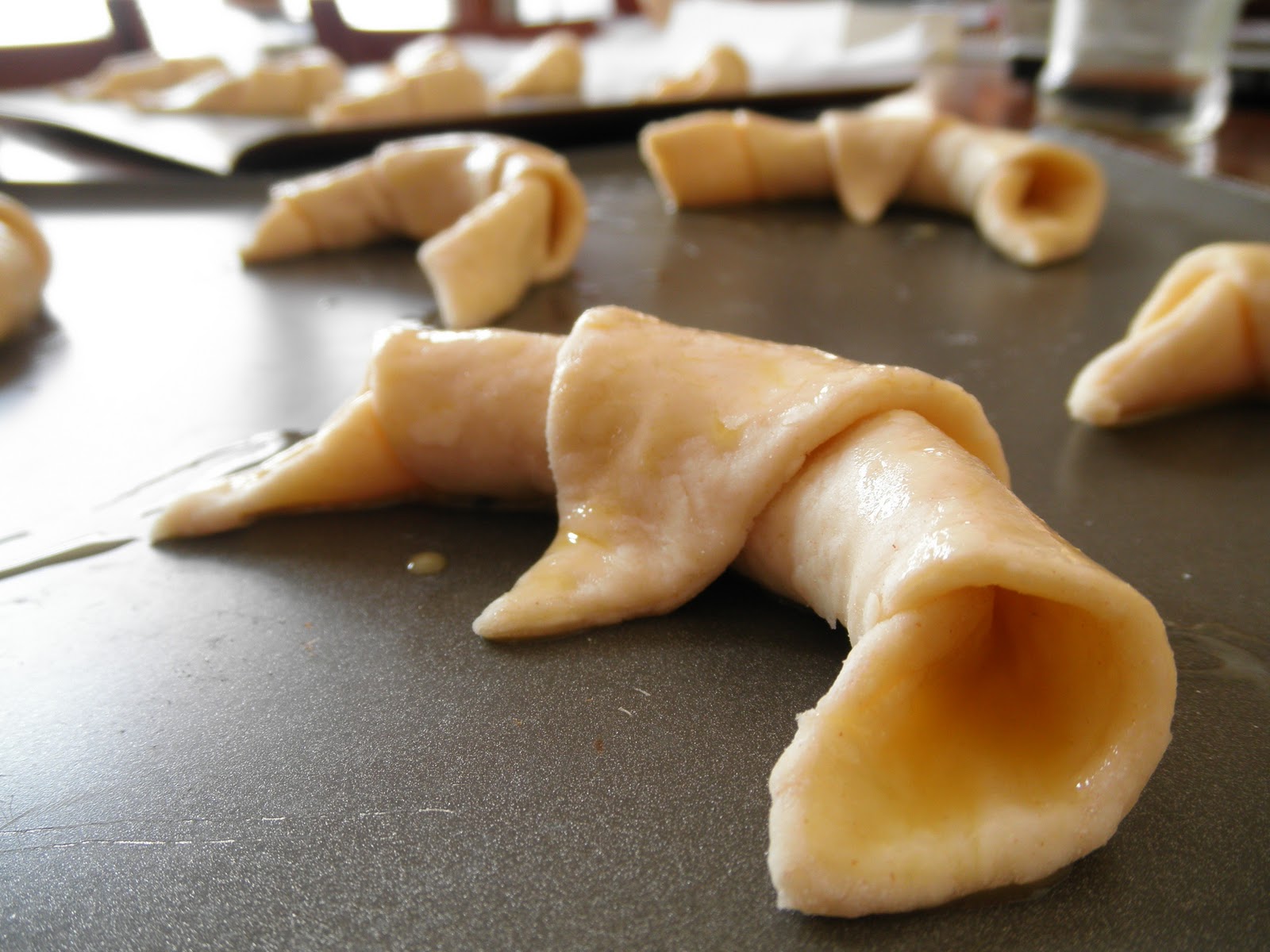
Freehand triangles for croissants with character
 
A light egg wash

Behold, le croissant. According to my bread book, Parisians like their croissants a deep brown, almost burned.
  
I think I'd make a fine Parisian.

Croissants probably shouldn't be made when one is craving croissants. The tedium of preparing the butter and kneading, rolling, folding, cutting, and shaping the dough would be frustrating to someone seeking instant gratification; then add the hours of cooling, rising, chilling, rising, resting, baking, shuffling, baking. The process is high-maintenance and long-winded, and it mustn't be cut short. Take it on when you have plenty of time and a scrupulous passion for every part of it. 
 

Thursday, February 3, 2011

Petit Pain au Chocolat


Chocolate-filled rolls: that was my next bread endeavor. I had my own illusions for what they would be like; I had experienced similar pastries at PAUL in London and at a tiny patisserie in the boulanger's promised land itself: France. It was there that I double-fisted a croissant and a pain au chocolat and discovered the ambrosial apex of the bread and chocolate rendezvous. So when I began my petits pains, I imagined soft semi-sweet chocolate enveloped in warm, buttery croissant-like bread. But the recipe didn't call for croissant dough - rather, I was to prepare brioche dough.

We made the dough the night before because brioche dough must be chilled when you work with it. It's a beautiful, sticky rich dough, thanks to five eggs and two sticks of butter.


After all the flour is added the dough is still sticky and in no shape for kneading. So instead of the push-turn-pull, B.C. introduced us to the pull-and-throw. Grab the dough in one hand, pull a large handful of it about 14" above the bowl, then throw it back "with considerable force." At first the action seemed futile - the dough was sticky and uncooperative - but it quickly became malleable. The gluten strands became stronger and more resilient with each throw, delivering a before-the-eyes demonstration of dough's metamorphosis.


 My mom and I gave the dough hell for twenty minutes (tag-teaming at five-minute intervals - not easy work!) then gave it a well-deserved three hour rest in front of the fire before stirring it down and putting it to rest in the fridge overnight.


The next day we found our dough refreshed and raring to be rolled out. It wasn't entirely easy, though. It took a bit of patience and a lot of flour to coax the dough into the specified length, width, and thickness. Don't be fooled by the photo - it looks so agreeable, doesn't it?


And now we really have fun. Enter chocolat.


After the chocolate is nestled inside and the brioche pinched shut, an egg and milk bath sets them up for a deep golden brown finish.


No, they didn't taste like my pains au chocolat from London and Paris - they didn't even look like them. But I have to respect brioche dough and how it comes to be, and I have to respect that, alas, I'm not a French baker - yet.

Croissants to come.

Tuesday, January 25, 2011

My First Loaf

All right, I have some news: I am no longer going to baking school. After much debate I officially withdrew last week. To be completely vague, it just didn't feel right at this point in my life. One of the nagging, recurring thoughts during my weeks-long deliberation: You started a blog about going to baking school! What now?

Well, it's really not too difficult: I keep baking. My goal to be a baker remains intact, and so will this blog. My latest undertaking? Yeast bread.


I received Bernard Clayton's New Complete Book of Breads as a Christmas gift a few years ago, and have only now found myself rich with the time and brain space it takes to start learning bread - from scratch. I read the introduction about Bernard's take on bread baking; I read through the ingredients and their functions; I read about equipment, leavening agents, kneading and rising. Then I had my pick of hundreds of recipes. Where would I begin my foray with bread? B.C. contributes his own suggestion for the first loaf, but I wasn't having it. I skimmed the table of contents and found the winner under French and Italian Breads: Pain Ordinaire Careme it would be.

The series began with stirring the flour, yeast, and hot water together, a movement all too familiar. Then I added more flour and the batter became dough; it was time to ditch the whisk and acquaint my hands with the tactual world of kneading. Why, there's nothing quite like working with bread dough. It's soft and giving, but it won't yield completely. Mere seconds into the push-turn-fold, push-turn-fold of kneading, the dough begins to push back, reminding me that I'm not the only force at work here. There's a presence in the dough, and it's got a small agenda of its own; whether or not it aligns with my plan is left at the mercy of a few controllable factors and a few uncontrollable ones, too. I lack the erudition required to explore those things you can attempt to control, but I can leave you with a suggested frame of mind for baking bread: don't let the active, dominating motions of kneading fool you; the transformation dough goes through to become bread is its own - you're just there to lend a hand.